
While much of the public discussion about the future of telecommunications in the Falkland Islands on OpenFalklands has focused on the expiry of Sure’s exclusive licence in December 2027, a potentially significant new development has emerged that deserves closer attention.
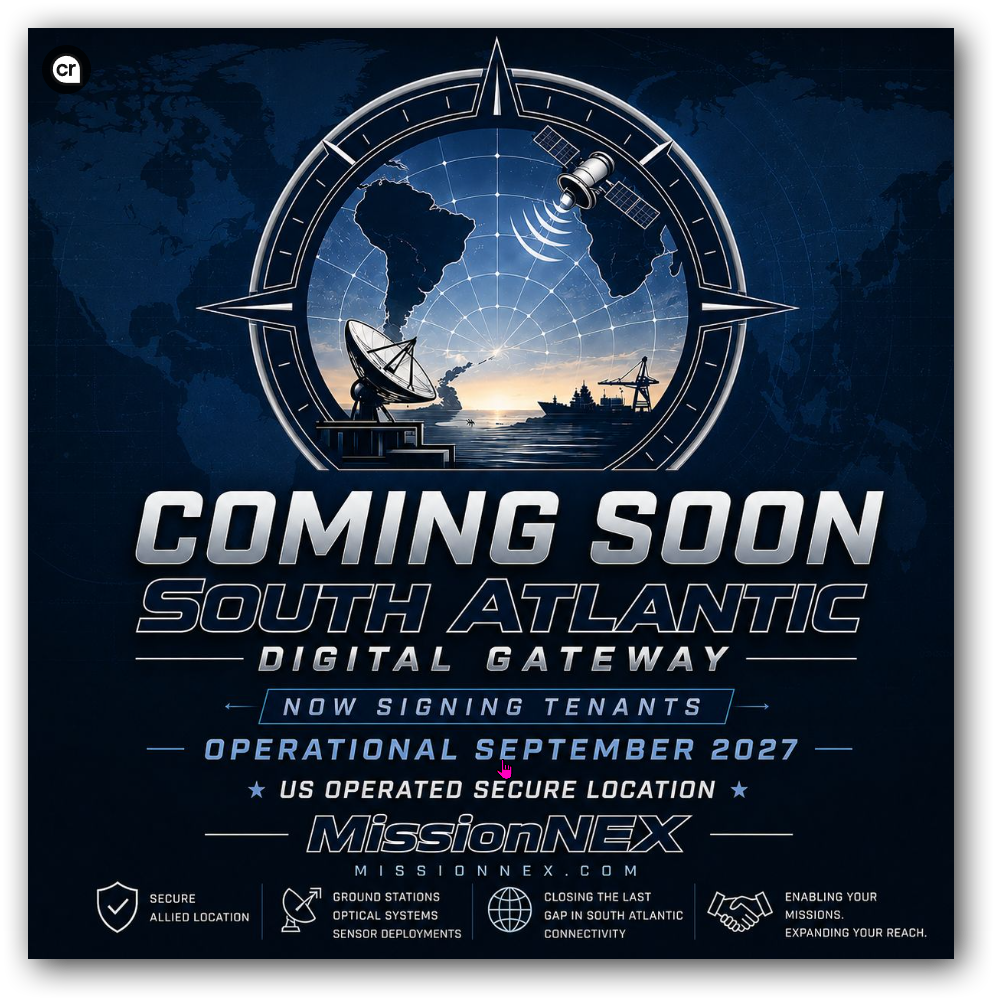
MissionNEX, a US-based company, announced the South Atlantic Digital Gateway on 30 May 2026, a planned secure communications and space infrastructure hub in the Falkland Islands. According to the company’s website (live from 12 July 2025) and a LinkedIn announcement published this week, construction is planned to begin in October 2026, with initial operations targeted for September 2027. It was stated that a subsea cable backhaul connection is anticipated for 2029.
Caveat: MissionNEX published detailed information about the South Atlantic Digital Gateway on its website in 2025 and on LinkedIn late in the evening on 30 May 2026. A few hours later, all the Falkland Islands-specific content (still available on the Wayback Machine) was removed. All information in this post was accessed from publicly available sources before the withdrawal.
Critically, MissionNEX states that it has already de-risked the long lead items that typically delay infrastructure deployment, including spectrum and operating licences, site control, and key permitting actions in the Falklands. This is not a company that has registered a website and is hoping for the best. It has done serious regulatory and legal groundwork inside the Falkland Islands system.
“We are now engaging prospective customers and partners interested in expanding operations into the South Atlantic region.”
Who Is MissionNEX?
The language on the company’s website is notable. References to allied governance, national security markets and government missions make clear that this is not a consumer telecommunications company. It is an organisation with ambitions in the defence and intelligence sectors, operating in a strategically sensitive location.
“The South Atlantic Digital Gateway is MissionNEX’s initiative to establish the Falkland Islands as a world-class communications and space infrastructure hub.”
Not a Competitor; An Enabling Infrastructure Partner
One of the most important clarifications MissionNEX makes is this:
“We are not competing with ground segment providers, system integrators, or mission operators. We are the enabling infrastructure partner that allows organisations to expand into the South Atlantic without the burden of developing a site from scratch.”
This changes how the South Atlantic Digital Gateway should be understood. MissionNEX is not positioning itself as a consumer broadband provider or a direct competitor to Sure. It follows a landlord model that provides secure facilities, licensed spectrum, antenna pads, satellite backhaul, security infrastructure, and logistics support, while other organisations deploy their own capabilities within it. The intended customers span commercial, civil and national security missions.
The Timeline and the Cable
The planned operational start of September 2027 coincides with the expiry of Sure’s exclusive licence. Whether that is by design or coincidence is one of several open questions. Construction start is October 2026.
Perhaps the most intriguing detail is the reference to cable backhaul arriving in 2029. MissionNEX states this with considerable confidence, describing the SADG as designed to operate on satellite backhaul until subsea cable service arrives, at which point it becomes a higher-capacity, fibre-integrated South Atlantic hub. No subsea cable connecting the Falkland Islands has ever been publicly announced. The question of where this cable originates and whether the Falkland Islands Government (FIG) is involved in its planning deserves a public answer.
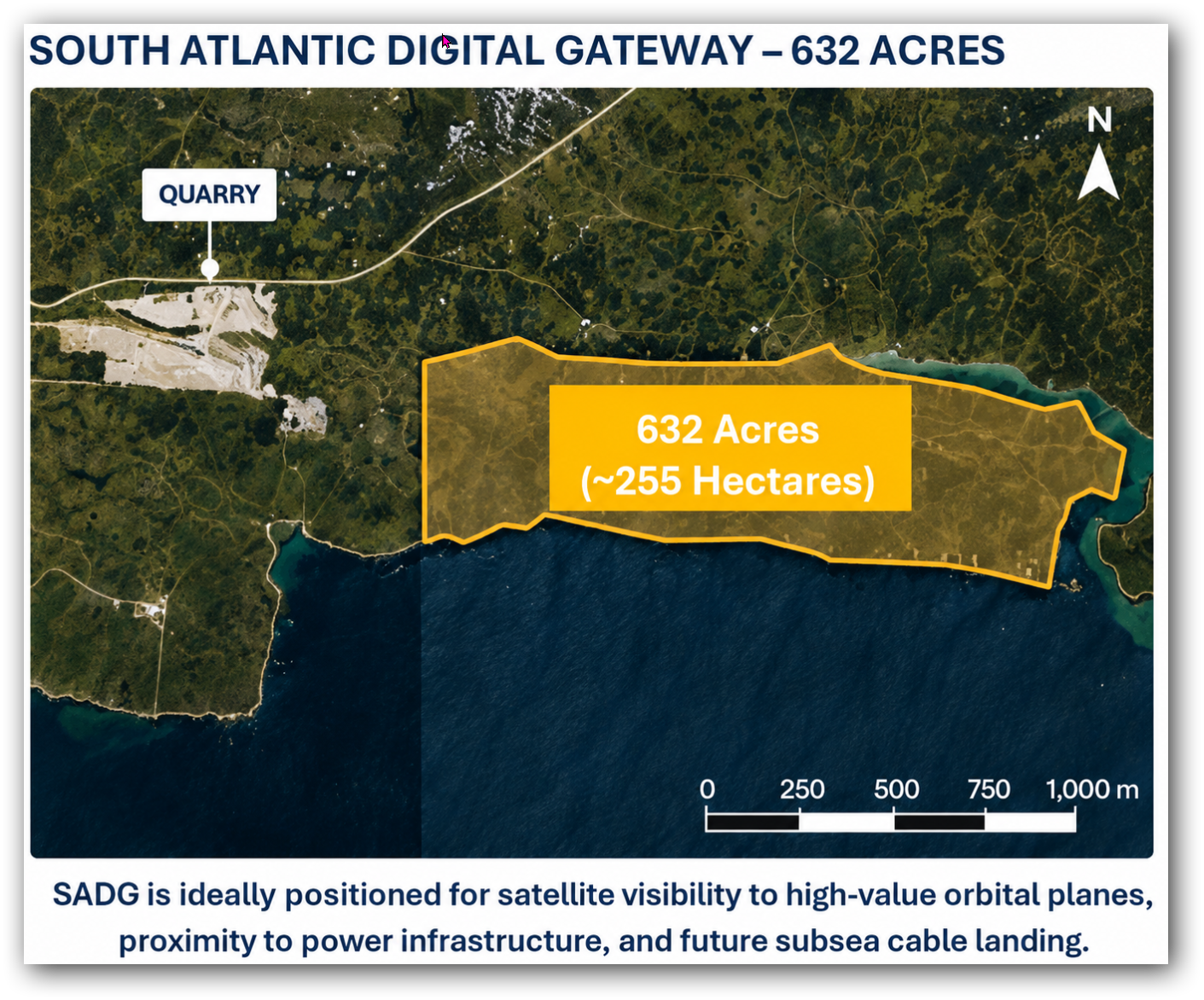
The proposed location for the initiative is Beckside Farm, which is owned by the Falkland Islands Development Council (FIDC) and is close to Stanley.
The Last Strategic Gap in Global Connectivity
This is the justification for using the Falkland Islands as the base of the SADG programme, according to the company’s website.
“The Falkland Islands occupy one of the most strategically significant positions in the Southern Hemisphere. Located between South America, Antarctica, Africa, and major maritime routes, the Islands sit within a critical geographic gap in global communications and space-ground infrastructure where few secure, allied-operated facilities exist today.
The region also provides proximity to the South Atlantic Anomaly, an area of particular interest to satellite operators, researchers, and government organizations due to its unique effects on spacecraft systems and orbital operations. Combined with a stable allied government, low RF congestion, and future subsea cable connectivity, the Falkland Islands offer a unique platform for communications, space operations, scientific research, and long-term infrastructure investment.”
The Questions That Need Answering
The emergence of MissionNEX raises a number of important questions.
- If the SADG is a viable project, how does this align with Sure’s exclusive telecommunications licence?
- Has MissionNEX been engaging with FIG through the same process that other telecommunications and infrastructure providers have been expected to follow in the PME programme, or has there been a separate track for this project?
- What is FIG’s relationship with MissionNEX? The fact that licences, site control and key permitting have reportedly already been secured suggests a level of engagement with FIG and the Communications Regulator that has not, to date, been publicly disclosed
- What are the governance and public interest implications of a US defence-adjacent operator establishing a major secure communications hub in the Falklands? Strategic infrastructure of this kind could bring significant benefits, but the dimensions of sovereignty and accountability warrant open public debate.
- And at what point does FIG intend to inform the public about this development and its implications?
Why This Matters
The South Atlantic Digital Gateway demonstrates that the Falklands are being viewed by serious international players as a strategically important location for communications infrastructure and that significant investment interest exists, apparently independently of the formal FIG process that has been the subject of so much public discussion.
That is both encouraging and thought-provoking. A development of this scale and strategic significance, with national security dimensions, subsea cable infrastructure, and US defence-adjacent operators, appears to have reached an advanced stage of preparation without any public announcement or consultation.
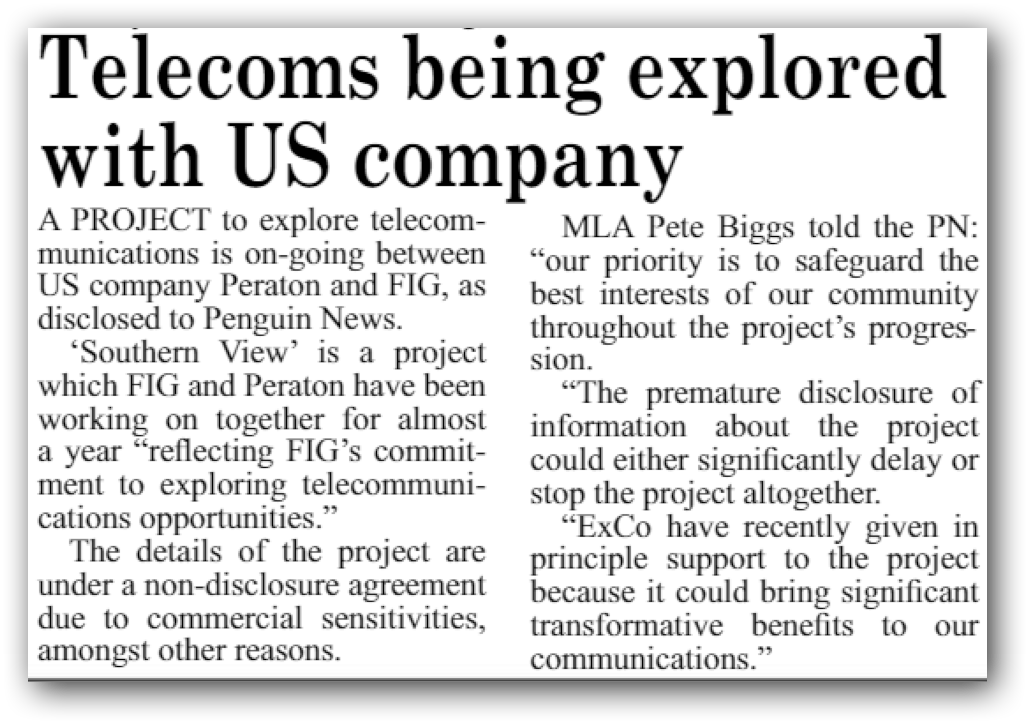
The origins of this activity trace back to a project described in the 10 April 2024 edition of Penguin News.
Personally, I still find the prospect of an undersea cable to the Falkland Islands incredibly challenging to accept. However, anything is possible with an appropriate level of financing by appropriate partners – especially if they are governments.
The community that fought for transparency over the Starlink petition deserves to know what is being planned in its name.
OpenFalklands will continue to follow this story closely. Readers with any knowledge of the South Atlantic Digital Gateway are warmly invited to make contact.

Chris Gare, OpenFalklands, June 2026, copyright OpenFalklands
We are seeing this type of activity more frequently lately, it’s akin to the ‘click bait’ stories on social media. Announce something as happening with the hope that investors will chase the idea and give it some credibility. Looks suspiciously like someone selling snake oil to me!