

An Unusual Reversal
In almost every telecommunications market in the world, fixed broadband outperforms mobile. Fixed connections generally offer higher speeds, while mobile networks, constrained by spectrum, shared cell capacity and the physical limits of a radio link, typically trail behind.
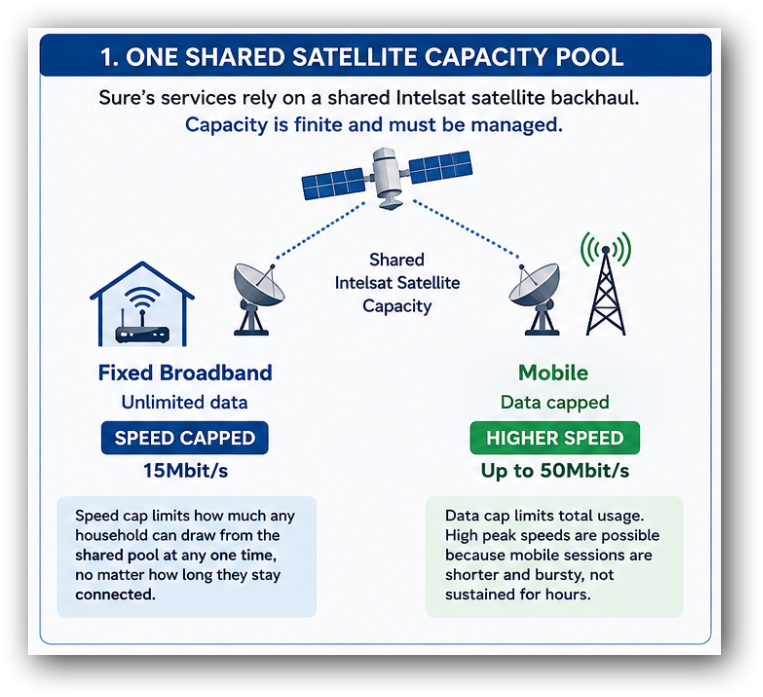
The Falklands now present the opposite picture. Sure’s mobile network offers download speeds of up to 50Mbit/s, more than three times faster than fixed broadband’s long-standing cap of 15Mbit/s. Fixed broadband does still offer unlimited data, which mobile does not. But on raw speed, the product traditionally regarded as Sure’s premium home service is now comfortably outpaced by a mobile SIM.
This is worth careful consideration. Why has fixed broadband remained capped at 15Mbit/s since December 2025 while mobile has been upgraded twice in just ten weeks?
Two Products, Two Different Levers on the Same Satellite Capacity
Part of the answer is straightforward and does not require any inside knowledge of Sure’s plans. A satellite backhaul link, whatever its total capacity, is a shared and finite resource. The real risk to that resource is not headline speed on its own, but sustained, aggregate demand across every customer using it at once.
Fixed broadband, now sold as unlimited, carries the greater risk of continuous, heavy use: multiple devices, streaming, backups and a connection left running all day. Capping the speed of that product, rather than the volume of data it carries, is a straightforward way to limit how much any single household can draw from the shared satellite capacity at any one time, no matter how long it stays connected.
Mobile usage tends to look different: shorter sessions and bursts of activity, rarely sustained continuously for hours. A high peak speed on mobile costs the shared pool comparatively little in practice because the data cap does the real work of limiting total consumption, regardless of how fast any individual burst happens to be.
Seen this way, the apparent contradiction dissolves. Sure is not necessarily treating mobile as the superior product. It is using two different technical tools, a speed cap and a data cap, to manage the same finite Intelsat satellite resource against two very different patterns of use.
Of course, there is probably a good technical reason for not upgrading fixed services beyond 15Mbit/s. The technology used on Sure’s Stanley network is ADSL2 with a maximum theoretical download speed of 24Mbit/s, as discussed in my 2025 post. With the ageing copper network in Stanley, it has been suggested that 15Mbit/s is the maximum that could be obtained for a reliable fixed broadband service.
Competition Changes Priorities
That technical explanation accounts for how fixed and mobile services are managed differently. It does not fully explain why Sure has chosen to invest visibly and repeatedly in one and not the other. Here, competition may provide a more commercially specific explanation.
Starlink has already reshaped fixed broadband in the Falklands. It offers materially higher speeds than Sure’s 15Mbit/s cap, no data quota at all, and has drawn a significant share of broadband customers away from Sure’s own network. Around 1,300 VSAT licences have now been issued, representing a remarkable level of adoption across the Islands and freeing satellite capacity that could potentially be used elsewhere on Sure’s network.
On fixed broadband, Sure is therefore competing against a rival offering a substantially faster, unlimited product and appears to have lost a significant share of that market.
Mobile is different. Neither Starlink nor Amazon currently offers a mobile telephony service. Direct-to-cell technology may eventually change that, but it is not expected to provide a realistic alternative here before around 2028. For as long as that remains true, mobile is the one major part of Sure’s consumer business where it faces no meaningful competition.
None of this proves why Sure made these decisions. The company has not publicly explained its technical or commercial strategy, and there may be factors that are not visible from outside. Nevertheless, the pattern of investment is informative in itself.
Fixed broadband, where Starlink already offers substantially greater speed, has seen no further improvement. Mobile, which Starlink cannot yet compete with in the Falklands, has been upgraded twice in ten weeks. Whatever the internal reasoning, the effect has been to direct visible, repeated improvement towards the one major part of Sure’s consumer business that remains unchallenged.
The Timing Is Hard to Ignore
This is happening as the Falklands Islands Government prepares to consider ExCo proposals later this month, August 2026, on the framework to replace Sure’s exclusive licence after December 2027.
Two substantial mobile upgrades within ten weeks present a visible story of continued investment and responsiveness ahead of those discussions. Whether coincidental or deliberate, the timing inevitably portrays Sure as a company continuing to invest in its network at a moment when the future structure of the telecommunications market is under consideration.
The upgrades may also have come at comparatively little cost if they are making use of satellite capacity freed as many fixed broadband customers have migrated to Starlink.
The Questions Worth Asking
None of this suggests that Sure’s decisions are unreasonable. Companies naturally invest where they believe it makes the greatest commercial and technical sense. But the pattern of recent investment does raise several legitimate questions that deserve clear answers from both Sure and the Communications Regulator.
Three questions naturally follow:
- Why has fixed broadband remained capped at 15Mbit/s while the mobile network has been upgraded twice in just ten weeks?
- If Starlink adoption has freed satellite capacity, could some of that capacity now be used to increase fixed broadband speeds as well as mobile performance?
- Does Sure have any plans to improve its fixed broadband service while Starlink continues to offer a faster, unlimited alternative?
Customers weighing up their options are entitled to understand not only what speeds are being offered, but why one part of the network is improving rapidly while another has remained unchanged.
One Other Change Worth Noticing
It is also worth noting that fixed broadband’s published package specifications are now less complete than they once were.
Archived versions of Sure’s website show that upload speeds were published for every fixed broadband package as recently as July 2024. By December that year, upload speeds had disappeared from the package information entirely, and they have not returned since, on either fixed or mobile packages.
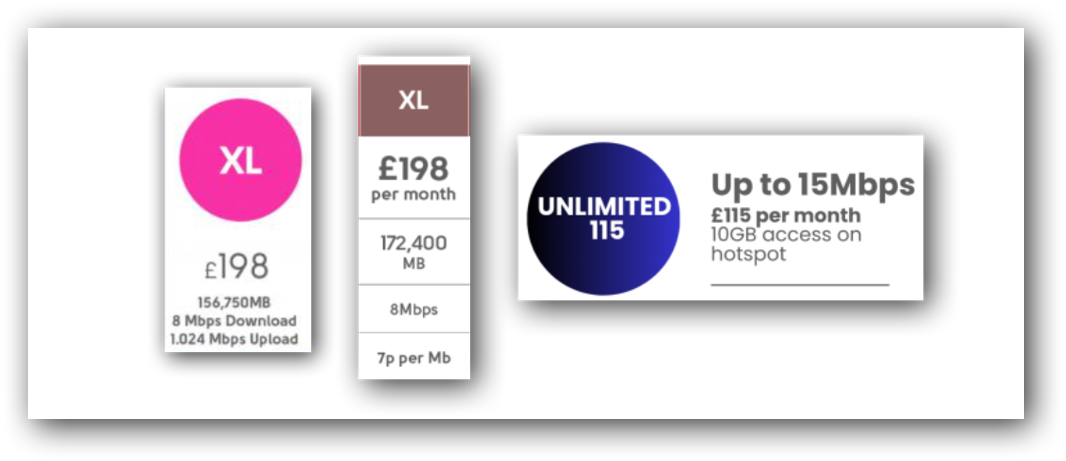
The upload speeds previously quoted were not unusually low by the standards of satellite or cable broadband elsewhere, so this is a minor point rather than a major one. But it means a customer comparing packages today has no published upload figure to go on.
Why does that matter? Upload speed is more important than it once was. Video calls, cloud backups, sending photos and large files, submitting documents and remote work of almost any kind all depend on how quickly data can leave a device, not just how quickly it arrives.
A customer choosing a package based on download speed alone therefore has no way of knowing from the published specification whether a video call home, a cloud backup or a business sending large files to the mainland will perform well on the plan they have chosen.
The Bigger Question
None of this is a criticism of Sure for investing in its mobile network. Companies naturally invest where customers remain and where they believe investment will have the greatest return.
The more significant question is whether the current regulatory framework creates the right incentives. Competition has already transformed one part of the Falklands telecommunications market. Starlink has demonstrated what happens when customers are given a genuine alternative: they exercise that choice, and the established market changes around them.
The debate now facing policymakers is whether similar competitive pressure should be allowed to shape the rest of the Falklands telecommunications market after 2027.

Chris Gare, OpenFalklands, August 2026, copyright OpenFalklands

That’s a really interesting contrast, especially with the rapid changes in mobile speeds. It makes you wonder about the long-term strategy for both networks.