I seem to have been posting more frequently than usual recently—not by design, but because quite a lot is happening in Falklands telecommunications at the same time. You must be getting bored with them after 7.5 years and 170 posts!
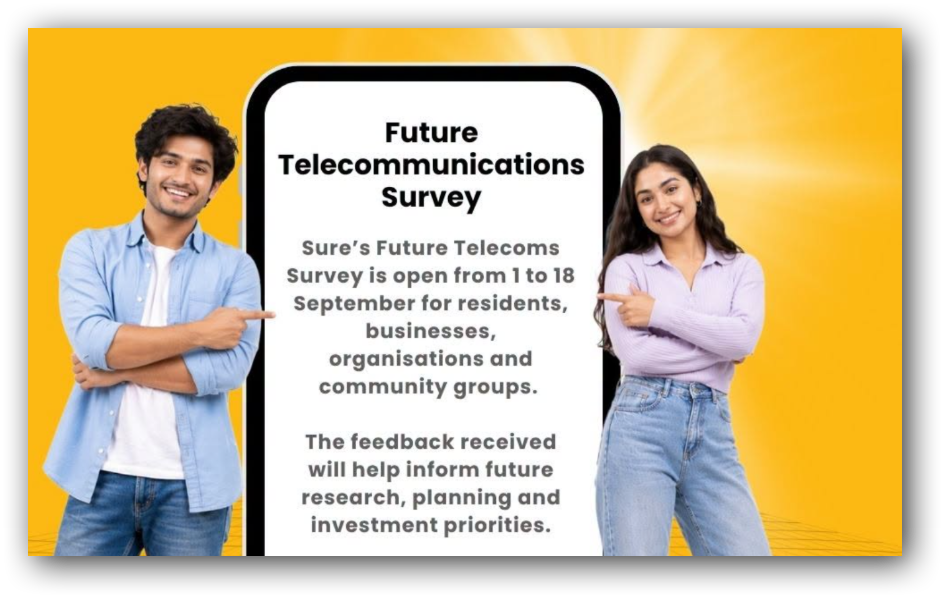
Sure Falkland Islands (Sure) recently invited consumers and businesses to take part in its September 1st to 18th Future Telecommunications Survey for the Falkland Islands, saying:
“Your voice can help shape the future of telecommunications in the Falkland Islands.”
I encouraged readers to participate in this survey in my posts, but I have waited until it was closed before commenting, as I didn’t want anything published on OpenFalklands to influence how customers responded. It is nothing unusual for any company to ask its customers what they need. Indeed, any company considering future investment and new services should do exactly that. But after looking carefully at the questions, I believe we need to make an important distinction.
Sure’s questionnaire is useful commercial market research. It is not a substitute for an independent consultation on what Falkland Islanders and businesses want the Falklands telecommunications market itself to look like after 2027. It shouldn’t be treated as such, despite the objective stated above.
In my previous post, “Before the Choices Close: What Should the Falklands Telecoms Consultation Ask?”, I argued that FIG needs to consult Islanders while the fundamental choices about the post-2027 telecommunications structure are still open. This is consistent with the case made in the Connected Falklands Group’s Select Committee request, which MLAs subsequently declined.
Sure’s questionnaire asks many sensible questions about what customers want from Sure. But that is fundamentally different from asking Islanders what they want from the future Falklands telecommunications system. Sure’s survey illustrates why that distinction matters.
A Useful Commercial Survey
Much of Sure’s questionnaire is good market research. Businesses are asked how critical telecommunications are to their operations, what happens if their internet connection fails, what improvements they need and whether they would pay more for a better business-grade service.
The survey also explores potential new commercial opportunities including cybersecurity, Microsoft 365 support, cloud backup, managed Wi-Fi, CCTV connectivity, technical support, Teams Voice and AI consultancy. These are all perfectly reasonable questions for Sure to ask. They could help the company understand what services customers might buy from Sure and where future commercial opportunities exist.
But they answer a different question from the one FIG needs to answer now. FIG needs to determine what telecommunications arrangements should follow the present exclusive licence after 2027. That involves questions about competition, infrastructure, ownership, wholesale access, resilience and the future role of different service providers.
Sure’s survey was not designed to answer those questions.
What Does “Local Provider” Actually Mean?
Question 7.4 asks:
“In the future, which option would you prefer?”
- A local telecommunications provider only
- A global satellite provider only
- A combination of local and satellite services
- Not sure
At first sight, this seems straightforward. But something important is missing. There is no option for competing telecommunications providers, nor for businesses that want local telecommunications infrastructure while remaining free to purchase services from different providers. A business using Starlink for broadband but wanting local mobile coverage, telephone services and technical support might reasonably select “a combination of local and satellite services.”
But that business has expressed a preference for a mixture of technologies and services. It has not expressed a preference for Sure to remain the local provider, nor has it said who should own or operate the local network after 2027.
Sure Is Sometimes Built Into the Question
Question 4.2 asks:
“Would your organisation value a resilient connectivity package combining Sure’s local network services with another backup satellite provision?”
That could be an attractive product, and it is entirely reasonable for Sure to test demand for it. But it doesn’t ask businesses how best to provide resilient connectivity. Sure’s local network is already part of the proposed solution. Similarly, Question 8.3 asks whether businesses would consider AI consultancy, implementation and support “if Sure were to offer” those services.
Again, perfectly legitimate commercial research. These questions are testing potential Sure products and services. They are not testing alternative structures for the Falklands telecommunications market. There is nothing wrong with that. It simply means the results need to be interpreted as such.
Local Does Not Necessarily Mean Sure
One question in Sure’s survey illustrates particularly well why independent consultation matters. Question 7.6 asks:
“How valuable is having a telecommunications provider with staff based in the Falkland Islands?”
I would expect many businesses to regard that as extremely important. Local engineering, technical support, fault response and people who understand Falklands conditions have obvious value. I certainly believe that local telecommunications capability should be retained and developed in whatever succeeds the present arrangements.
But supporting local telecommunications capability is not the same thing as supporting one particular telecommunications company. A different future market structure could still employ Falklands-based engineers, technicians and customer-service staff. Indeed, preserving and developing those skills should itself become an explicit requirement of whatever arrangements FIG puts in place after 2027.
The distinction is important: businesses can strongly support retaining local telecommunications expertise without expressing any preference about which company should provide their telecommunications services after 2027.
Sure Should Have a Seat at the Table — But Not Define the Table
Sure unquestionably has a legitimate place in the discussion about what happens after 2027. It operates the existing network, employs local people, possesses considerable knowledge of Falklands telecommunications and will quite reasonably have its own proposals for the future.
Its customers should also have a voice. But neither Sure’s commercial interests nor its customer research should define the boundaries of policy discussions. That is FIG’s responsibility.
The government should set the questions that need answering, present realistic alternatives, and allow businesses and consumers to express views on those alternatives before deciding the fundamental structure of the future market. That would complement Sure’s survey rather than undermine it. Sure can ask: What services would you buy from us?
FIG needs to ask: What telecommunications system do you want the Falkland Islands to have? Those are both legitimate questions. They are simply not the same question.
The Questions Sure’s Survey Does Not Ask
This is where the distinction becomes important. Sure’s survey asks customers what services they need, what problems they experience and what additional services they might buy. Those are useful questions for a telecommunications company.
But it does not ask whether Islanders want competition between providers, who should own future telecommunications infrastructure, whether competing providers should have access to common infrastructure, what obligations should be imposed on whoever operates that infrastructure, or how the future market should balance terrestrial and satellite services.
Nor should we necessarily expect Sure to ask those questions. They are public-policy questions, not customer-research questions.
I set out the questions I believe FIG’s consultation should address in my previous post. Sure’s survey reinforces the reason why that separate exercise is needed.
What This Means for the Consultation
None of this criticises Sure for conducting customer research. On the contrary, if Sure is considering future investment and new services, it needs to understand what its customers want. The results could also provide useful evidence for FIG.
The problem would arise if the results of a commercial survey were subsequently interpreted as expressing Islanders’ preferences about what the future telecommunications market itself should look like.
A preference for local staff is not necessarily a preference for a particular provider. A preference for combining local and satellite services is not a preference for a particular market structure. And willingness to buy additional services from Sure tells us little about who Islanders believe should own, operate or have access to future telecommunications infrastructure. Those questions require a different process.
Sure’s survey can tell us a great deal about what customers may want from Sure. It cannot tell FIG what telecommunications framework Islanders want after 2027, because it was never designed to ask them.
So rather than merely asking how Sure interprets its survey results, I would go further. FIG should now ask Islanders the questions that Sure, quite reasonably, did not.

Chris Gare, OpenFalklands, September 2026, copyright OpenFalklands