
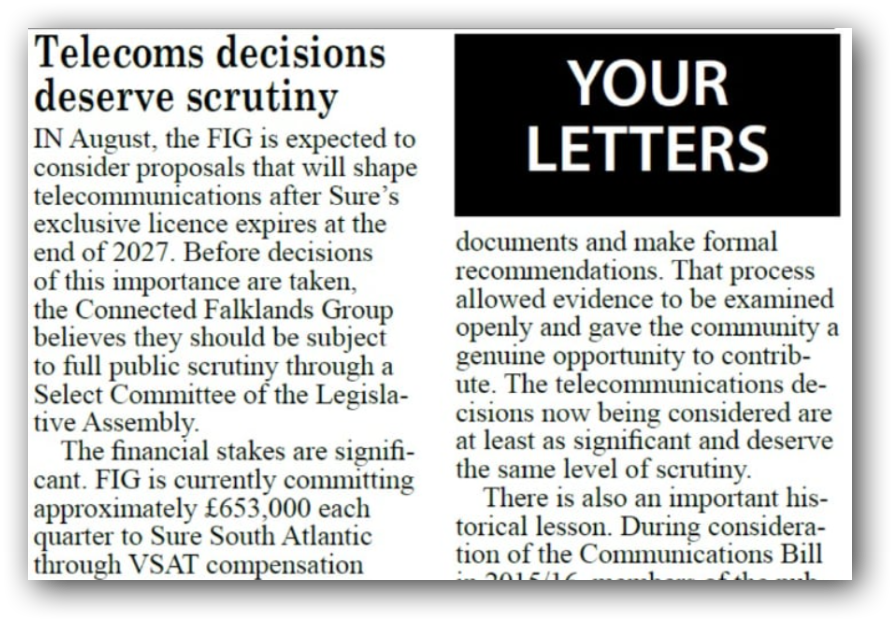
Following the Connected Falklands Group letter published in the 17th July 2026 issue of the Falkland Islands’ Penguin News, several people have asked what a telecommunications Select Committee would actually do.
PDF version of the six posts – The case for a Telecommunications Select Committee

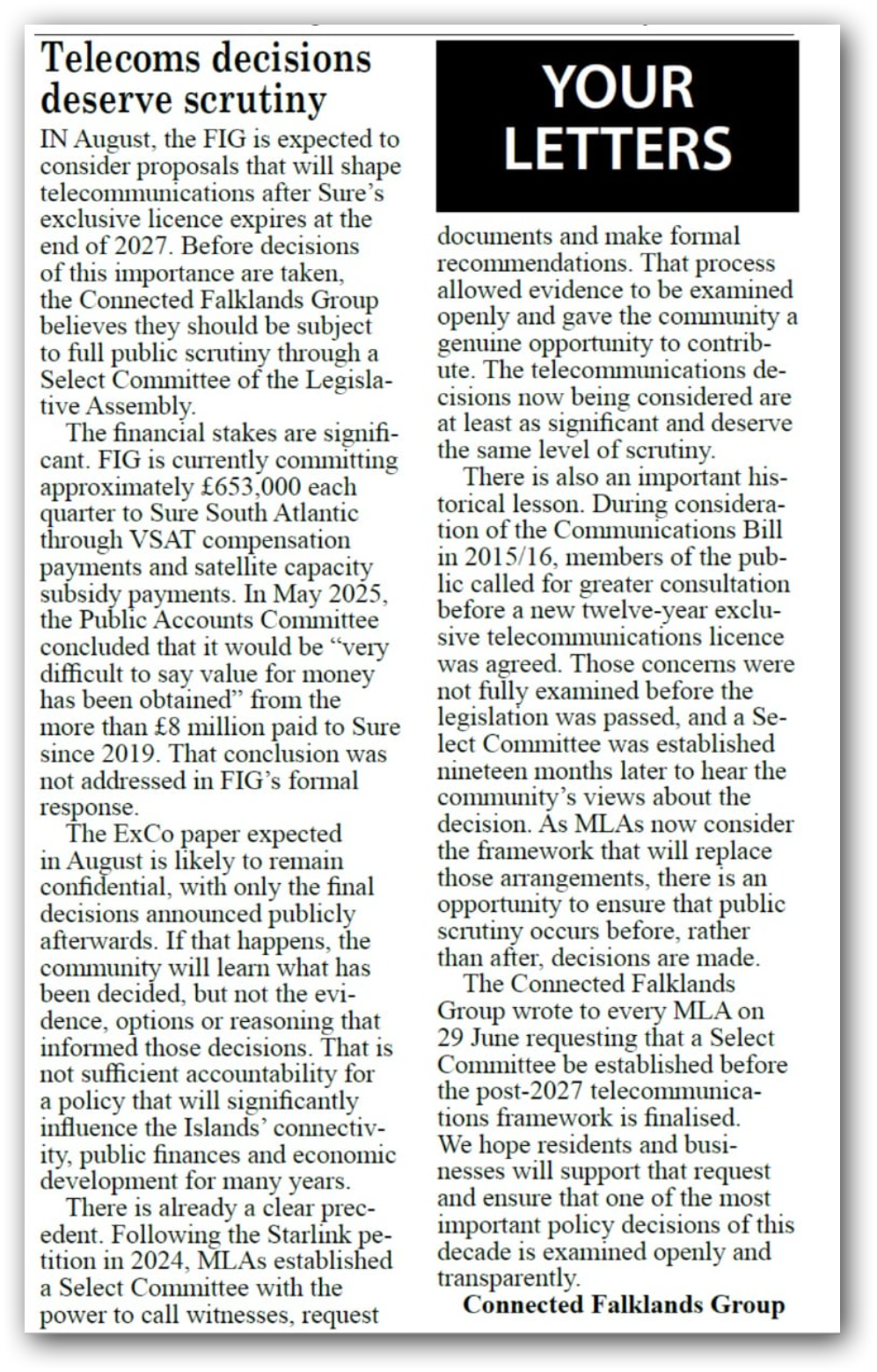
A Select Committee would not negotiate with telecommunications companies or attempt to conduct negotiations itself. Nor would it replace the Executive Council (ExCo) in making policy decisions. Those responsibilities remain with MLAs sitting as the ExCo. Its role would be to scrutinise the evidence, hear from witnesses first-hand, consider, and make informed recommendations to the Legislative Assembly while there is still time for those recommendations to influence the final decisions.
It is also worth explaining why a Select Committee is preferable to even a well-designed FIG public consultation. Public consultations are organised by the Falkland Islands Government (FIG), which decides how questions are framed, how responses are gathered, how community views are summarised, and how those findings are presented to MLAs. However thorough the process, MLAs ultimately receive FIG’s interpretation of the evidence. A Select Committee works differently. MLAs hear witnesses directly, question them themselves, and produce their own recommendations rather than relying on a summary prepared by the organisation whose proposal they are being asked to consider.
That is particularly important for the post-2027 telecommunications framework. The decisions taken over the coming months will influence connectivity, public expenditure, economic development and digital infrastructure for many years. They deserve more than confidential consideration within FIG and its advisors. They deserve independent scrutiny before the direction of travel is fixed.
The Select Committee should therefore examine, through written and oral submissions, all realistic options rather than simply FIG’s preferred proposal. It should hear evidence from FIG officials’ proposals and observations, the Communications Regulator, Sure South Atlantic, and independent technical experts. It should understand what realistic alternatives have been considered, why one approach is being recommended, and what assumptions underpin that recommendation.
Just as importantly, if not more so, it should hear directly from the people who use telecommunications every day.
Businesses understand the importance of reliable, affordable communications for investment, tourism, retail, farming and the wider economy. Residents understand the practical realities of service quality, reliability, affordability and customer support. Their experience cannot be replicated by consultancy reports or financial models. Their evidence should help the Select Committee compare the strengths and weaknesses of the available options before adopting a preferred approach, rather than simply commenting on a proposal after it has effectively been chosen.
This is perhaps the most important lesson from 2016.
The 2016 Select Committee established under the Communications Bill undoubtedly carried out valuable work. However, by the time it met, the strategic decision to negotiate a new twelve-year exclusive licence had already been taken. The committee therefore examined legislation implementing that decision rather than helping the Legislative Assembly evaluate the strategic alternatives beforehand. Many businesses and members of the public felt that their opportunity to influence the direction of travel had come too late to have any meaningful impact.
The opportunity in 2026 is different. Before ExCo reaches its final conclusions, the Select Committee has an opportunity to hear evidence, debate the competing options and understand the implications of each. A Select Committee can ask difficult questions, challenge assumptions, and test whether the preferred approach truly represents the best outcome for the Falkland Islands. If changes are needed, they can still be made. If the evidence is compelling, the Assembly can proceed with greater confidence.
Given the importance of the post-2027 telecommunications framework, it is hoped that all MLAs would serve on the Telecommunications Select Committee, as they did for the 2024 VSAT petition. There is a clear precedent. The Legislative Assembly Order Paper of 25 July 2024 proposed that the petition be referred to “a Select Committee comprised of all Elected Members of the Assembly”.
A Select Committee should help shape the decision before it is made, not simply review it afterwards. Scrutiny by the Assembly is not an obstacle to FIG. It is one of the ways better government decisions are reached. For a decision that will shape the Falkland Islands’ telecommunications scenario for the next decade and beyond. That is precisely the role a Select Committee should fulfil.

Chris Gare, OpenFalklands, July 2026, copyright OpenFalklands
A Facebook discussion that took place about FIG’s need for “private thinking spaces” a few days ago was brought to my attention and is relevant to the current request to establish a Telecommunications Select Committee.
It is worth understanding the limits of FIG’s approach to information disclosure. FIG is entitled to protect what it describes as a “private thinking space” for officials and advisers engaged in developing policy. Under this principle, internal deliberations, draft documents, working papers and internal communications can be withheld from public information requests on the grounds that published consultation documents provide a sufficient basis for public participation.
That argument may be entirely reasonable in many circumstances. But it also illustrates exactly why a Select Committee matters. A Select Committee has statutory powers that a public consultation does not. It can hear directly from key witnesses and request access to information that would not otherwise enter the public domain. Information that may properly be withheld from the public under FIG’s normal disclosure arrangements is not subject to the same considerations when a Select Committee exercises its statutory powers. That is not a theoretical distinction. It is the difference between the community being invited to comment on FIG’s conclusions and the Legislative Assembly being able to examine the evidence, test the reasoning and make informed recommendations before final decisions are reached.
In practice, protecting a “private thinking space” for FIG officials and advisers is entirely compatible with establishing a Select Committee. The two serve different but complementary purposes: one allows policy to be developed within government, while the other enables the Legislative Assembly to scrutinise that policy before final decisions are made.