
In yesterday’s OpenFalklands post, I speculated on what the MV Fugro Supporter surveying vessel was doing while visiting the Falkland Islands – Could the South Atlantic Be The Next Cable Frontier?
As a follow-up to that post, I asked a colleague (Thank you!) to extract recent track data for the MV Fugro Supporter from various Automatic Identification System (AIS) sources to gain as much insight as possible into its activities during its visit to the Falklands.
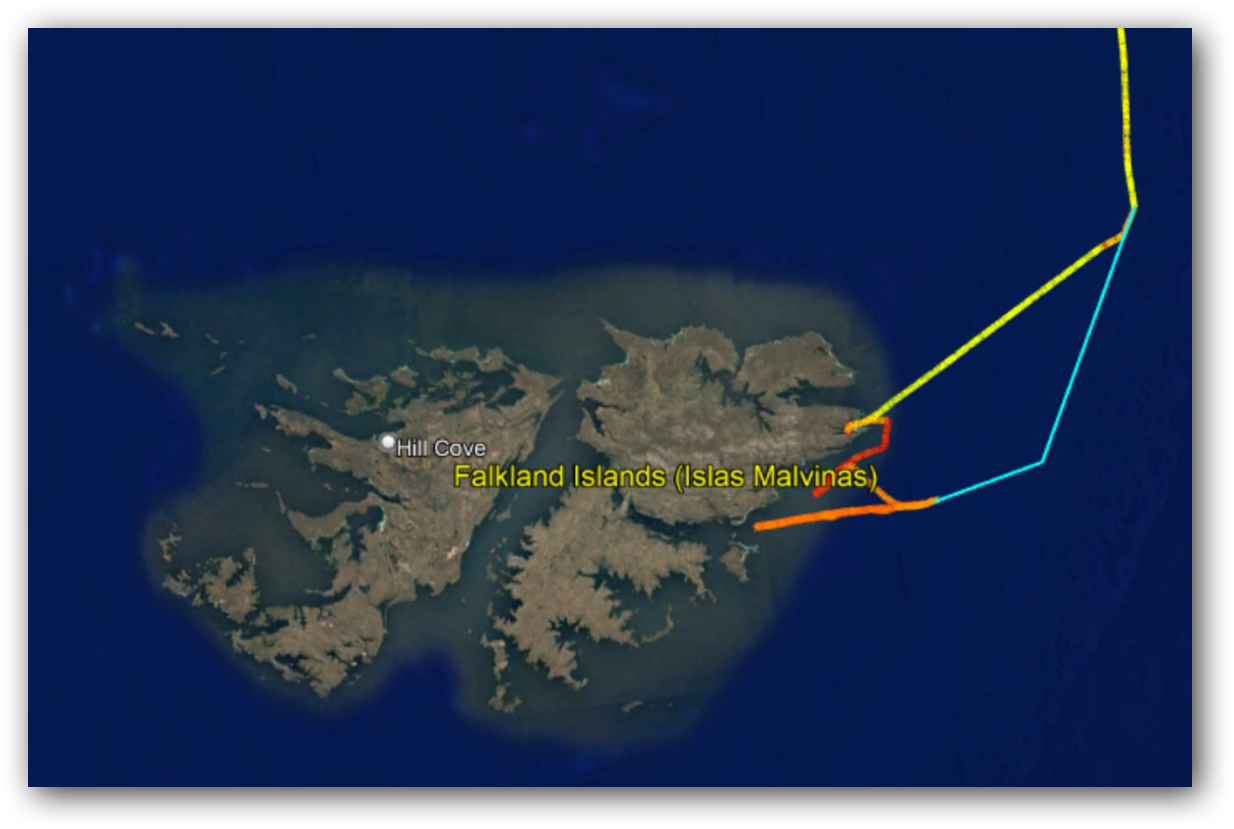
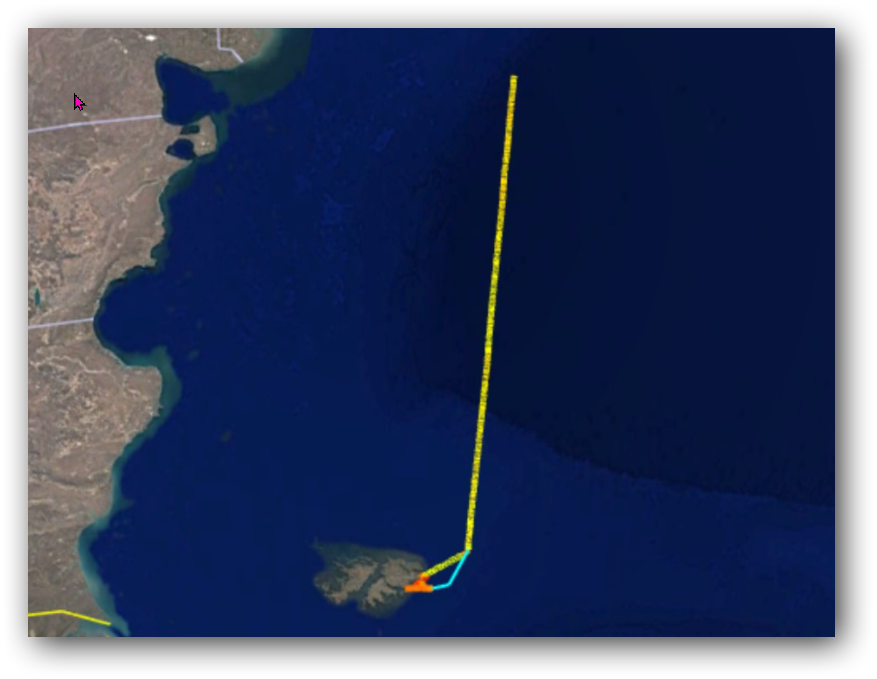
The vessel has been in Falkland waters since the third week of May 2026 and appears to have surveyed a route into Mare Harbour. The red, yellow and green lines indicate the track followed by the vessel. The light blue section represents a suspected missing segment for which no AIS data is available. The vessel is now on a direct course to Montevideo, Uruguay.
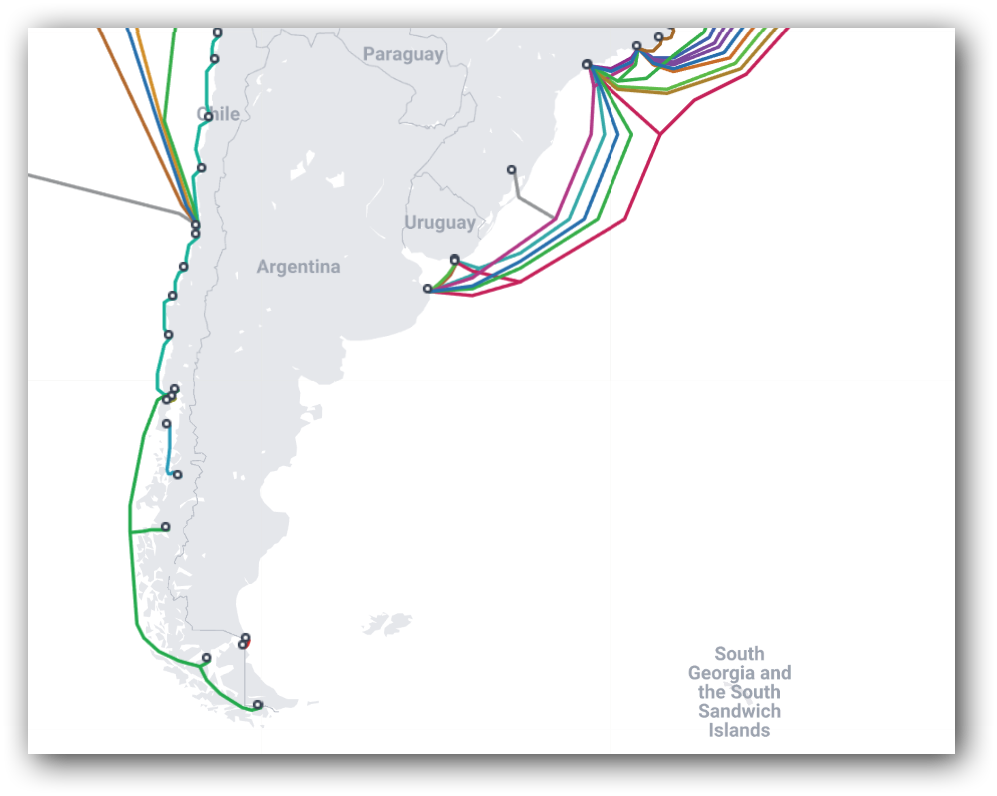
It was conjectured in the previous post that the speculative Google cable would be terminated in Uruguay, so the path taken by the MV Fugro Supporter is quite interesting.
Mare Harbour is the principal military and logistics port in the Falkland Islands. Located adjacent to RAF Mount Pleasant, it was constructed after the 1982 conflict to support the British military presence and provide a deep-water port capable of handling large vessels. This might indicate the involvement of the UK or US military.
Several industry parties have indicated to me that, accounting for routing considerations, a submarine cable between the two locations would likely be around 2,000–2,200 km long. For a cable of this length, a ‘ back of a fag packet’ capital expense cost would be £100m. Annual operating costs might reasonably be expected to be in the order of approximately £3 million per year.
The fact that a survey vessel appears to have been operating in or near the restricted Mare Harbour military port raises further questions that go beyond cable surveying. A commercial cable would not be landing here, I would suspect. Do not forget that a fibre link would need to be commissioned to connect Mare Harbour to Stanley, which would be an obvious target for Falkland Islands Government ownership.
Montevideo in Uruguay is a major hub for undersea fibre optic cables, making it a key gateway for international connectivity in the South Atlantic and South America.
Interestingly, its speed of around 10 km/h (5.4 knots) is probably too slow for a simple transit passage, but with its linear path, it is entirely consistent with the speeds typically associated with marine route surveys. It may therefore be possible to conclude with reasonable confidence that the MV Fugro Supporter has been undertaking some form of marine route survey. If so, one possible interpretation of the track is that it indicates a cable route between Mare Harbour and Montevideo.
The exact speed depends on the type of survey being undertaken:
Typical Survey Speeds
| Survey Activity | Typical Speed |
|---|---|
| Multibeam bathymetry (seafloor mapping) | 4–8 knots |
| Side-scan sonar survey | 3–6 knots |
| Sub-bottom profiling | 4–7 knots |
| Detailed geophysical survey | 2–5 knots |
| ROV or seabed inspection work | 0–2 knots |
| Transit between survey areas | 10–15 knots |
Of course, this remains entirely speculative, and the survey’s nature and purpose cannot be determined from AIS data alone.
OpenFalklands will continue to follow this story closely. Readers with any information regarding the activities of the MV Fugro Supporter are warmly invited to get in touch. It is hoped that the Falkland Islands Government will make a public statement on the matter in due course and that local media will ask them questions.

The 1915 Falklands Telegraph Cable
In 1915, the British Admiralty commissioned a submarine cable between Stanley and Montevideo. The cable was operated and maintained by staff from the Western Telegraph Company. Its purpose was strategic rather than commercial, providing secure communications during the war.
Before the cable, international communication relied on the Marconi wireless station at Wireless Ridge, which had opened in 1912. Internal communications within the islands were already provided by a growing network of telephone lines linking Stanley with Darwin and other settlements.
The cable appears to have had a relatively short life. According to the history of the Western and Brazilian Telegraph Company:
“During the 1914–18 war a cable was laid from Montevideo to the Falkland Islands for the Admiralty. After the war the cable was abandoned.”
This suggests that the cable ceased operation shortly after the First World War, probably around 1919 or the early 1920s.
The photo below shows what we believe is the telegraph cable entering the seawall immediately in front of Cable Cottage on Cable Street, next to the Secretariat. (Photo credit: Peter Beardmore)

Chris Gare, OpenFalklands, June 2026, copyright OpenFalklands

That’s a really interesting thought about using AIS data. It makes a lot of sense that tracking ship movements could offer insights into what they’re surveying there.