
 Over the past six years, the Falkland Islands have experienced four significant, publicly acknowledged network incidents that disrupted the entire island, rather than being confined to a single settlement or group of customers.
The incidents had different immediate causes. But that is precisely what makes them worth examining together. Different failures, at different points in the network, have repeatedly produced the same island-wide consequence.
This post looks at what happened, what Sure has invested in between these incidents, and why a three-year-old commitment to make “network design changes to protect the service” deserves another look.
Credit Where It Is Due
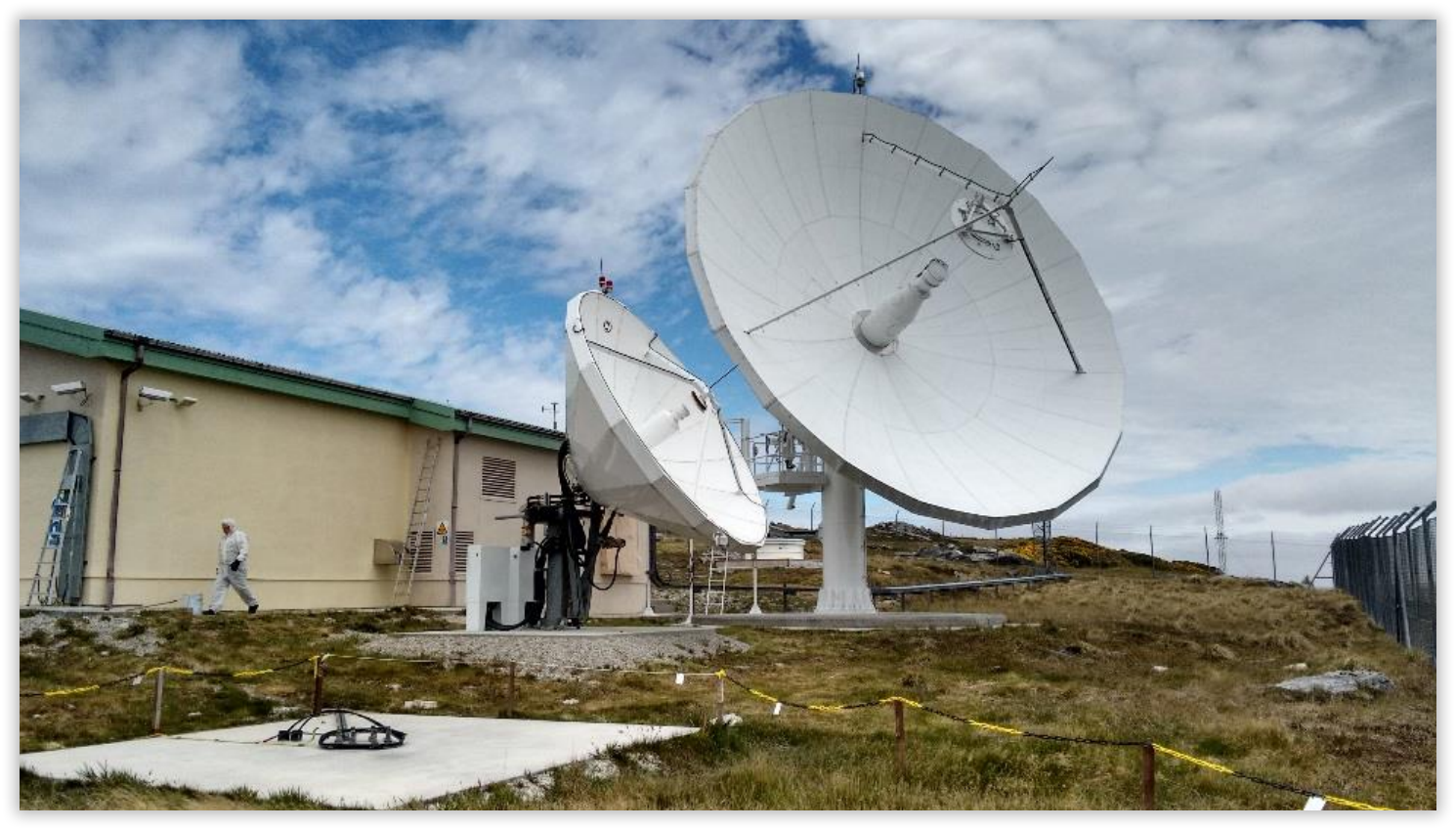
It would be wrong to suggest Sure has done nothing. Sure invested in a genuinely significant piece of infrastructure: a second geostationary satellite dish at its Stanley earth station, linked to Intelsat 10-02, alongside the existing dish connected to Intelsat 37e satellite. Sure South Atlantic’s (Sure) 2023 accounts say it planed to install a new 9-metre antenna at the Earth Station, associated with its satellite provider, Intelsat, and introduce lower-latency services in the form of eight OneWeb LEO antennas. That is real capital investment, not a marketing announcement.
And, during the September 2025 outage, that investment did something. It restored partial connectivity via the OneWeb service, providing a genuine, independent alternative path that had not existed a few years earlier.
Four Island-Wide Incidents Across Six Years
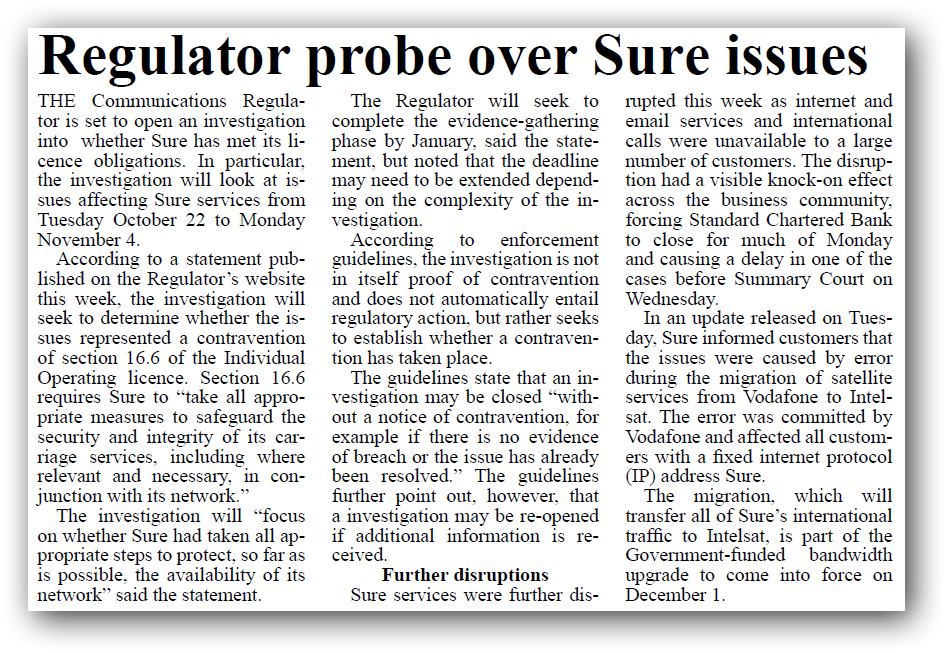
25 November 2019: What began as a planned four-hour outage associated with work to increase satellite capacity turned into a much longer and widespread loss of connectivity, with disruption continuing well beyond the planned maintenance window. Intermittent issues continued into early December. OpenFalkland’s own coverage at the time recorded the outage firsthand, from a Wi-Fi hotspot in Stanley and the Malvina Hotel, with no connectivity found anywhere on the island.
18 March 2023: An island-wide outage affecting internet, 4G and some phone services, Sure said, was caused by a partial equipment failure. Sure’s statement said engineers had identified the faulty equipment and were “implementing network design changes to protect the service,”. That week’s Falklands in Focus also covered the outage and its aftermath, in an interview with MLA Mark Pollard, who is now the Falkland Islands’ Communications Regulator, the office responsible for holding Sure to account on the resilience questions such as those discussed here if one occurs again.
June 2024: Sure and Intelsat attempted to bring a new “multi-orbit” architecture into live service, combining GEO and OneWeb LEO capacity into a single routing system. When activated, it caused a major, island-wide outage and had to be rolled back. The trial was formally withdrawn.
Kris Ball of Falkland Islands Radio interviewed Roma Stewart, CEO and Mark Heron, Chief Technology Officer of Sure, Falkland Islands, in their Stanley offices to better understand the issues.
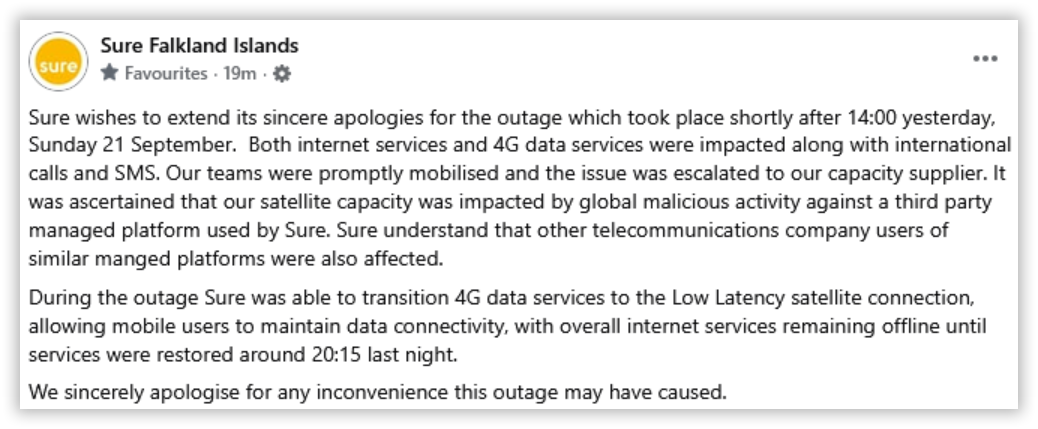
21 September 2025: A complete island-wide broadband blackout lasting just over seven hours, caused by a failure on the Intelsat GEO satellite link, despite the second dish having been installed in 2023. Using OneWe Sure restored some 4G connectivity across the Islands, but only after roughly four hours into the outage, and not automatically. Fixed broadband itself remained down island-wide for the full seven hours.
Different Failures — The Same Island-Wide Consequence
The immediate technical causes were different, and that distinction matters. But from a resilience perspective, another common feature emerged: a failure or intervention in one part of the system could affect telecommunications across the Islands.
A local equipment fault causing a local outage is unavoidable in any telecommunications network. What deserves examination is why such different failures have repeatedly escalated into an island-wide event.
A Promise Made in 2023, Still Unverified in 2026
In March 2023, Sure publicly committed to “network design changes to protect the service” following an island-wide outage. That commitment is now over three years old.
Sure has not publicly explained what those design changes involved, whether they were completed, or what failure scenarios they were intended to protect against. Since then, two further island-wide incidents have occurred.
That does not prove the promised changes failed. But it does make it reasonable to ask what resilience they were intended to provide and what has subsequently been done to prevent different failures elsewhere in the network from producing the same island-wide consequence.
There has certainly been investment. Sure has added a second GEO satellite link using a separate satellite and ground antenna, together with OneWeb LEO connectivity. That represents genuine additional infrastructure. But redundancy is not the same thing as end-to-end diversity, particularly where both GEO satellite paths ultimately depend upon the same satellite operator and potentially shared terrestrial infrastructure.
On paper, that looks like resilience. In practice, different failures have still caused island-wide disruption. And when an alternative path was available using OneWeb in September 2025, it was invoked manually, hours into the outage, rather than automatically and quickly enough to prevent an island-wide impact.
Why This Matters Now
None of this is about dredging up four old incidents for their own sake. It matters because FIG is currently shaping the framework that will govern telecommunications provision after 2027, and service resilience and diversity is exactly the kind of requirement that is easy to leave implicit and hard to retrofit later. A framework that simply continues today’s arrangements, however it is badged, risks inheriting today’s resilience gaps unless it explicitly addresses them.
The reasonable, proportionate question is not why Sure hasn’t built an uneconomic network in which nothing can ever fail. Networks fail. Resilient network design is about what happens when they do.
The question is what “network design changes” were made after the 2023 outage, what level of resilience they were intended to provide, and why subsequent failures have still produced island-wide disruption.
With FIG now considering the telecommunications arrangements that will follow the present exclusive licence, end-to-end diversity, automatic failover and the elimination of avoidable single points of failure should be explicit requirements of whatever comes next.
Ultimately, the real test will be what happens the next time something fails. Sure may already have made further changes that have not been publicly described, and if those changes mean that a future equipment, satellite or routing failure no longer develops into another island-wide outage, that will be the strongest evidence that resilience has genuinely improved. We may only know that the network has become more resilient when the next failure occurs and most customers never notice it. Let us hope that is exactly what happens.