The 17th September edition of Penguin News provides a little more information about the telecommunications paper ExCo considered in August.
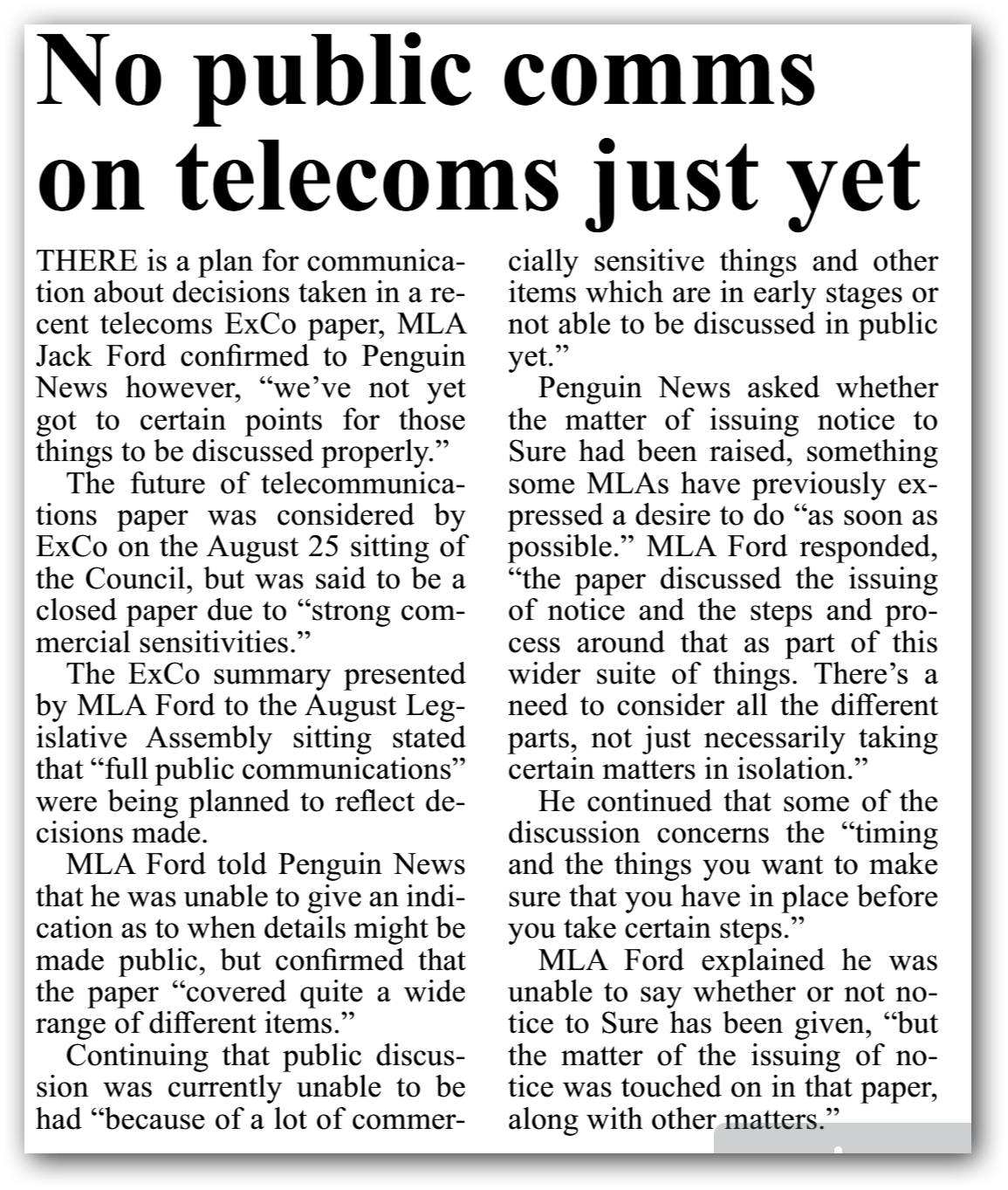
MLA Jack Ford confirmed that it discussed issuing notice to Sure South Atlantic (Sure), its timing, and the process, but he would not say whether notice has actually been served. That matters because notice is not simply an administrative step. It starts the contractual process of ending the current exclusive licence arrangements and the transition that follows. Yet we still do not know whether ExCo authorised it, whether notice has been served, or when it will be.
Public communications are promised, but there is an important distinction: public communication and public consultation are not the same thing. Further work, and potentially further ExCo decisions, appear likely before the eventual direction is settled.
FIG says those models are still being shaped. If the public is to have any meaningful influence, this is the time for consultation – before further decisions or commercial negotiations with Sure or other interested parties narrow the choices. So what should that consultation actually allow Falkland Islanders to consider?
1. Consultation While the Choices Are Still Open
Timing matters more than almost anything else. The Assembly has already committed to giving stakeholders opportunities to understand and comment on future proposals before making significant implementation decisions. As I’ve stated many times, I would go further: consultation should take place while the key strategic choices themselves are still open to influence.
There is a substantial difference between asking: “Here is what we propose to do – what do you think?” and: “Here are the realistic choices available to the Falklands. Which direction do you think we should take, and why?”
Recent developments in St Helena make that distinction particularly relevant. St Helena Government has signed a Memorandum of Understanding with Sure to progress a major upgrade of its telecommunications networks. Although a new licence has still to be agreed, the proposed arrangement envisages government-owned infrastructure being operated and maintained by Sure.
That could also change the context in the Falklands. Sure now has a developing partnership model with another South Atlantic government which it could reasonably seek to pursue in the Falklands. Sure would therefore argue that FIG should negotiate a similar future arrangement with the existing operator rather than put telecommunications services back on the international market
That is why the earlier statement from FIG’s Chief Executive remains particularly important:
“The Falkland Islands Government still intends to give notice to Sure and to run an international process to decide on the future of telecommunications in and for the Falkland Islands.”
Is that still the intention? If it is, the promised consultation should take place early enough to influence the options that eventually go to market. If FIG is now considering another route – including negotiating a new or transitional arrangement directly with Sure – it should also make that clear before the choices narrow.
St Helena demonstrates just how much telecommunications policy can evolve. SHG originally pursued a formal competitive process and in 2022 selected Maestro, rather than Sure, to build its new fibre network. I wrote about this then. However, they are now negotiating with Sure again.
There is an obvious lesson here for the Falklands, but it is not simply that replacing an incumbent is difficult or that retaining one is necessarily the right answer. Changing provider and changing the structure of a telecommunications market are not the same thing. What matters is whether the eventual arrangement produces the ownership, investment, competition, accountability and service outcomes the Falkland Islanders and businesses actually want.
FIG should therefore be particularly clear about whether its commitment to an international process still stands. The public should be involved before the destination has been chosen, not simply asked what it thinks of the route after the decision has effectively been made.
2. Explain the Realistic Options
Telecommunications policy can become technical very quickly. Terms such as wholesale access, neutral host, infrastructure separation, open access and spectrum policy mean little to most people unless their practical consequences are explained.
FIG should therefore set out the realistic post-2027 options in straightforward language. I expect the two unpublished Cambridge Management Consulting reports contributed considerably to those internal discussions. For each realistic option, I would like to see the same basic questions answered.
What would it mean for consumers and businesses? Who would own the infrastructure? Who would operate it? Where could competition realistically occur? What investment would be required? What would happen to local employment and expertise? What are the principal risks? And what could it mean for prices, service quality and resilience?
Some theoretically attractive models may simply be impractical in a market as small and geographically unusual as the Falklands. If so, explain why. Consultation cannot be meaningful if people are asked to express a preference without being given enough information to understand the alternatives.
3. Ask About Outcomes, Not Just Providers
The debate should not simply become a choice between Sure, Starlink or some other company. Those are providers. The more fundamental question is what the Falklands wants its future telecommunications system to deliver.
Consumers and businesses should be asked about reliability, affordability, resilience, local support, investment, service quality, choice and the ability to adopt future technology. How important is locally based engineering capability? How important is an alternative communications route during a major failure? What level of mobile coverage should be expected in Camp? What broadband performance should Stanley expect over the next decade?
These questions matter because they establish the objectives against which different market structures and providers can subsequently be assessed. Decide what the Falklands needs before deciding who should provide it.
4. Put Infrastructure Ownership on the Table
One subject I particularly want included is ownership of the underlying core telecommunications infrastructure. If Stanley’s ageing copper network is eventually replaced with fibre, who should own that fibre? When will the mobile network be upgraded to VoLTE and finally retire the 2G network, which should have been undertaken a while ago? Should one retail telecommunications company control it? Should FIG own core strategic infrastructure? Could an independent wholesale operator manage it? Similar questions apply to mobile towers, backhaul and other infrastructure.
These are long-term decisions. Infrastructure installed during the next few years could shape the telecommunications market for twenty years or more. The community should understand the choices before making those decisions.
5. Include Starlink — But Don’t Make It the Whole Debate
Starlink has fundamentally changed the Falklands telecommunications environment. It provides consumers and businesses with an alternative means of internet connectivity that did not exist when the present exclusive arrangements were created. Any credible consultation must recognise that reality.
But Starlink does not provide every telecommunications service the Falklands requires. Local mobile coverage, emergency communications, telephone services, local infrastructure and technical support remain important. The question should therefore not be: “Sure or Starlink?” It should be: How should satellite and terrestrial networks complement one another in the future Falklands telecommunications system? That is a much more useful discussion.
6. Publish What People Say — And What FIG Does With It
This is absolutely essential for me. At the end of the consultation, FIG should publish all submissions, not just a summary of the responses, and should explain how they influenced the eventual policies. This would have been one of the important benefits of the Select Committee approach – everyone would be able to see what their colleagues said. A process based primarily on a small number of meetings around the Islands, with FIG providing only a condensed version of participants’ views, would not provide that same transparency and would be quite questionable.
Not every public preference can or should become government policy. Financial, legal, technical and strategic considerations may shape the eventual decision in ways the community cannot fully see. But where FIG ultimately chooses a substantially different direction from a strongly expressed public preference, it should explain why.
Consultation should create a visible connection between what people say and what government subsequently decides. Otherwise, participation risks becoming little more than evidence that people were given an opportunity to comment.
The Bigger Question
I would have preferred a Select Committee – and still do – because it could have provided a structured, public mechanism for examining many of these questions while the options were being evaluated. That is not the route MLAs chose, even though the Starlink Select Committee was deemed extremely successful by all who participated.
So the challenge now is to make the promised public engagement sufficiently substantial that businesses, consumers and other stakeholders can genuinely contribute before the important choices are closed. I am not suggesting that public opinion should determine every technical or commercial decision. FIG ultimately has to make those decisions and accept responsibility for them.
But the community should be able to understand the realistic choices, express its priorities and see how those views influenced the outcome. For me, that is the test of meaningful consultation.
Not simply: “Were people asked what they thought?” But: “Were they asked early enough, given enough information, and provided with a genuine opportunity to influence what was eventually decided?”
That is what I want to see from the next stage of the Falklands telecommunications review. If this is not achieved, then a comprehensive independent telecoms review of Sure and FIG may be required.

Chris Gare, OpenFalklands, September 2026, copyright OpenFalklands